Bangladesh’s Security Crisis: Should People Be Allowed to Keep and Bear Arms?
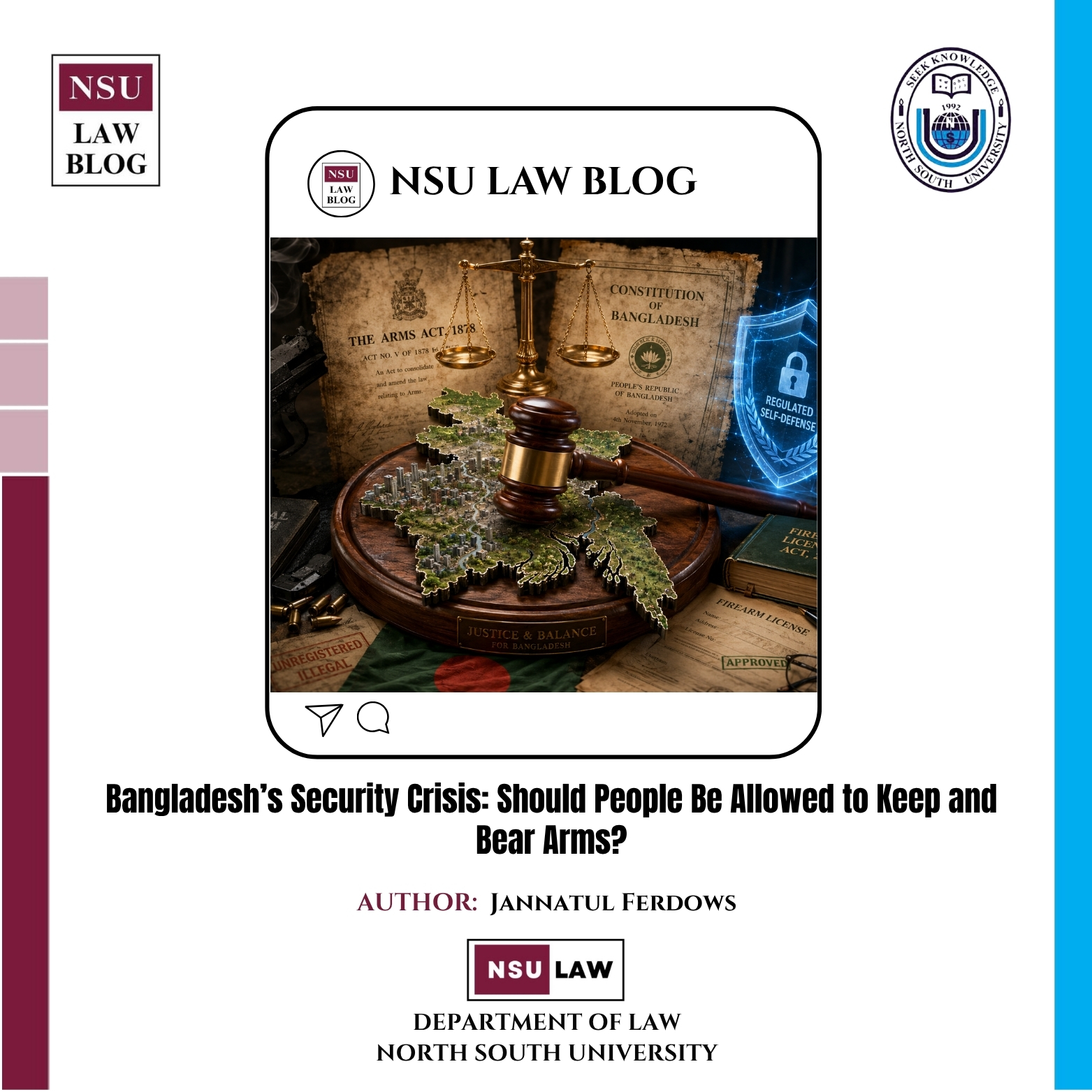
The constitutional and legal framework of Bangladesh recognizes the right to self-defence. The “Right to life and Personal Liberty” is discussed in Article 32 of the 1972 Constitution of Bangladesh, while sections 96 to 106 of the Penal Code of 1860 specifically established provisions for self-defence. One can use necessary force, even lethal force in extreme scenarios to protect himself or others. But the restrictions imposed by the Arms Act of 1878, which limits the private ownership of firearms and carrying sharp objects by citizens and bestowed the responsibility almost entirely to the law enforcement agencies, the question arises, “If crime is armed, why not the people?”
The government of Bangladesh followed the philosophy that arms in civilians’ hands might increase violence rather than preventing it. Instead of allowing self-defence weapons under the Arms Act of 1878, a colonial-era law from British rule and later modified, the Government of Bangladesh emphasizes state control over security. In this way, Bangladesh transferred the individual’s right to bear arms entirely to the law enforcement agencies of the state, and the law-abiding citizens remained unarmed. Though getting permitted to keep a firearm requires a license under section 13 of this act, in reality, it is deliberately rigorous.
It is estimated that there are about 200,000 illegal firearms in Bangladesh, and about 600 to 700 illegal firearms enter the country every day through its borders. On the other hand, as of November 2023, Bangladesh had 213,000 police officers, a ratio of 127 Police officers per 100,000 people, far below the UN’s ratio of 1:450. Seeing this disparity, it is unrealistic to depend solely on the Police regarding citizens’ security. Ineffective or delayed response of the Police leaves people vulnerable at the time of an armed attack. In this situation, not permitting arms to the citizen could be considered reneging on the constitutional promise of the right to life.
One might argue that allowing arms in every hand might create anarchy or make it a real challenge to maintain law and order in Bangladesh. But crime and violence stem from poverty, lack of education, and weak law enforcement, not just gun availability and even though we agree, anarchy might increase. Still, it’s not a satisfactory argument because whoever is involved in breaking the law and order will ultimately get a gun, because of the availability of illegal weapons. It doesn’t make sense that stricter arms policy would make a change for the better. It will just deprive the law-abiding citizens who are already victims. In this case Bangladesh could implement a strict background and mental health checking policy, and strict punishment for misuse before licensing guns. Countries like Switzerland and Finland have widespread gun policies in comparison, they have very low crime rates due to strong regulation and responsible ownership. Thus, the problem is illegal weapons, not the licensed ones.
Comparative research would be more logical to look at. The Czech Republic recognized the right to bear guns for self-defence in 2021 when it revised its Charter of Fundamental Rights and Freedoms. The homicide rate in Czechia (0.8 per 100,000) is still lower than the EU average (0.9 per 100,000), per Eurostat (2022). Following the legalization of the right to bear arms, there was no increase in gun-related fatalities. The Disarmament Statute (2003), which prohibited civilian gun ownership except in certain circumstances, established stringent gun control laws in Brazil. President Jair Bolsonaro loosened gun control regulations in 2019, permitting individuals to possess up to four firearms without demonstrating a need for them. He maintained that those who were armed could defend themselves against criminal activity. Well, whether the gun-related crimes deteriorated or not, the aftermath in Brazil could be a different debate. Only permitting private arms could worsen the scenario if it is not well regulated. But looking at the necessity where illegal arms are so available and the armed crime rate is high, law enforcement agencies face a real challenge to maintain the safety of the citizen in a timely manner, there should be no bar for the citizens to ensure their own safety. They should be permitted with licensed arms for self-defence.
Denying law-abiding citizens right to self-defence while criminals remain armed is a failure of justice. With overstretched law enforcement and rising armed crime, responsible firearm ownership is not a threat but it’s a necessity. Bangladesh must empower its citizens with strictly regulated access to arms to uphold security and constitutional rights.

Jannatul Ferdows1 Posts
0 Comments